After Emancipation

1619
"The Misguided Focus on 1619 as the Beginning of Slavery in the U.S. Damages Our Understanding of American History
The year the first enslaved Africans were brought to Jamestown is drilled into students’ memories, but overemphasizing this date distorts history" By Michael Guasco
SMITHSONIAN.COM
SEPTEMBER 13, 2017
"Unfortunately, 1619 is not the best place to begin a meaningful inquiry into the history of African peoples in America. Certainly, there is a story to be told that begins in 1619, but it is neither well-suited to help us understand slavery as an institution nor to help us better grasp the complicated place of African peoples in the early modern Atlantic world.


A Ku Klux Klan party
Title: A Ku Klux Klan party in Western North Carolina. (Could be in Polar, NC.)
Title: Plan of the contemplated murder of John Campbell
Date: 1871.
Photographer: Charles Emory Smith.
Source: Library Company of Philadelphia.
Description: Altered photograph depicting the “Plan of the Contemplated Murder of John Campbell.” Shows nine Ku Klux Klansmen (comical faces drawn on their hoods) surrounding a kneeling noosed white man - John Campbell - holding his hat.

African American Property Valuation 1900
Title: [A series of statistical charts illustrating the condition of the descendants of former African slaves now in residence in the United States of America] Assessed value of property owned by Negroes in three states of the United States.
This chart is part of the African American Photographs that Dr. Du bois Assembled for exhibition at the 1900 Paris Exposition

Alexander Lightfoot Manly
Mr. Alexander Lightfoot Manly
November 10, 1898
In the fall of 1898, when an angry White violent mob numbering in the thousands burned The Daily Record, the Black community of Wilmington lost its most important voice in editor Alex Manly.
---
Note: we are adding two background writings about Mr. Alexander Lightfoot Manly. End Note.
---
The Voice of Black Mecca
By Kevin Maurer
In the fall of 1898, when an angry violent White mob numbering in the thousands burned The Daily Record, the Black community of Wilmington lost its most important voice in editor Alex Manly


Anthony Crawford
New Documentary On Wealthy SC Black Cotton Farm Owner Who Was Lynched For Success
By Kalyn Oyer /Post And Courier Nov 17, 2020 Updated Nov 23, 2020
In 1916, just over half a century after slavery was abolished, a wealthy Black farmer who drew the ire of his jealous and bigoted White business peers in Abbeville was murdered by a lynch mob.

Asa Fitzgerald
A Personal Act of Reparation
The long aftermath of a North Carolina man’s decision to deed a plot of land to his former slaves.
By Kirk Savage
Sunday, December 15, 2019
Five years after the abolition of slavery and in the midst of a violent campaign to reimpose white supremacy fueled by the Ku Klux Klan across the ex-Confederate South, a Methodist minister in the remote mountain town of Waynesville, North Carolina, carried out an act of reparation apparently unprecedented in U.S. history. Asa Fitzgerald signed an extraordinary land deed in August 1870, conveying most of his remaining property to nine “colored persons” he and his wife’s relations had formerly enslaved. He transferred the land explicitly as restitution for the many years of unpaid labor “performed by them and their ancestors while in slavery.”
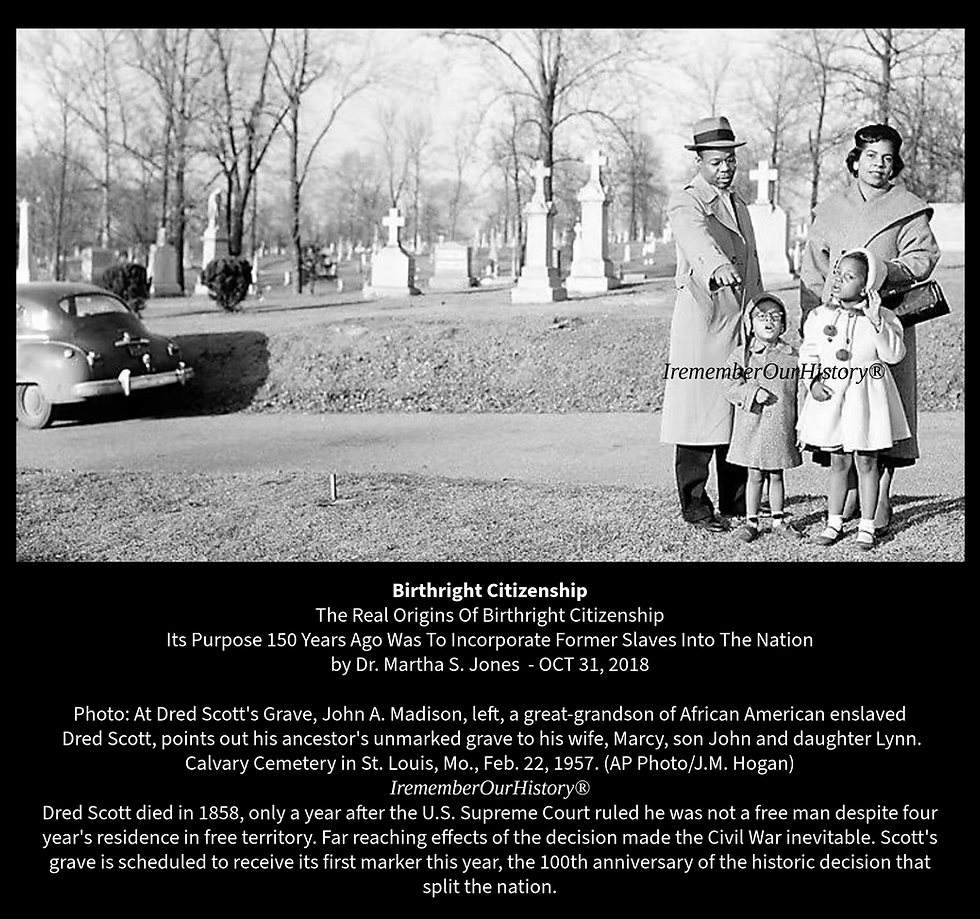
Birthright Citizenship
The Real Origins Of Birthright Citizenship
Its Purpose 150 Years Ago Was To Incorporate Former Slaves Into The Nation..
by Dr. Martha S. Jones - Society of Black Alumni Presidential Professor at Johns Hopkins Universities
Photo: At Dred Scott's Grave, John A. Madison, left, a great-grandson of African-American slave Dred Scott, points out his ancestor's unmarked grave to his wife, Marcy, son John and daughter Lynn. Calvary Cemetery in St. Louis, Mo., Feb. 22, 1957. (AP Photo/J.M. Hogan)

.png)
Black Legislator (unidentified) Speaking To Assembly in the North Carolina State House
Reconstruction Years - When these states were reorganized under their new constitutions, they were required to ratify the 14th Amendment, which would allow them to regain their seats in Congress. North Carolina ratified the 14th Amendment on July 4, 1868 and was readmitted to the Union. In 1869, the 15th Amendment was passed by Congress, prohibiting any state from denying a citizen the right to vote because of race, color, or previous condition of servitude. North Carolina ratified the 15th Amendment on March 5, 1869.


Blackbeard's Ship
hen you read about Blackbeard's ship being found in Old Topsail Inlet in North Carolina, now known as Beaufort Inlet. NC, the Queen Anne's Revenge, what you might not see, is that before he stole the ship, it was called the La Concorde and was a French slave ship.
It depends on what you read and who wrote it.
Many accounts of this "exciting find" do Not include the Back story of the ship's history.

City Cemetery
"Preservationists hope to restore 12 graves at City Cemetery, Raleigh’s oldest, in the historic section dedicated for slaves and free blacks. Few of those names remain, and markers are fading." - Josh Shaffer
Slave cemetery fights for life. ‘I’m haunted by who the descendants are of these folks.’
In 1811, a slave known only as Cato died of consumption in Raleigh, taking his rest in the corner of City Cemetery reserved for the black departed.

Colonel H.L. Pike
"Slaves no more--free men forever" is a quote from an address by Colonel H. L. Pike at an Emancipation Day Celebration in Raleigh, 1870.
Image: The Daily Standard Raleigh, December 25,1869 published an ad announcing a gathering for the seventh anniversary of Emancipation Day on January 1, 1870.


ESSEX HARRIS And the Ku Klux Klan in Chatham County, North Carolina
Image: Retaliation charges - State vs. Essex Harris & Sampson Perkins. Judgment of the Court that the defendants Essex Harris and Sampson Perkins be imprisoned for five years in the Penitentiary of this State in Raleigh this the 18th of May 1872.10.
Source: Chatham Co Historical Society - Researched by Jim and Beverly Wiggins, February 2022; Revised April 2025

Ed Roach
Black Community in Roxboro, NC, Required to Leave or Face Racial Violence
eji
On October 13, 1920, members of the Black community in Roxboro, North Carolina, were terrorized by an ongoing campaign from a white lynch mob, threatening them to leave their homes or face racial violence.
In July 1920, a mob of local white residents in Roxboro seized an innocent Black farmworker, Ed Roach, from the Person County Jail where he was being held for the alleged assault of a white girl.

Effects of the Proclamation
160 years ago on December 31, 1862 the Emancipation Proclamation was signed by President Lincoln.
Image: Harper’s Weekly, Effects of the Proclamation, Freed Negroes Coming Into Our Lines at New Bern, North Carolina, February 21, 1863.
Description:
“Effects of the Proclamation, Freed Negroes Coming Into Our Lines at New Bern, North Carolina,” was an illustration that appeared in Harper’s Weekly on February 21, 1863.


Family of Enslaved People
This family of enslaved people was photographed in the Washington area in 1861. Slavery seemed almost omnipresent then, but it was abolished in the District the following year.
Photo courtesy of the Library of Congress
"Love was something that was torn out of the hands and hearts of the enslaved Black people in NC. This was true for pretty much all enslaved Black people forced into chattel slavery in America.


Freedmen’s Bank
Jun 28, 1874, The Freedmen’s Savings and Trust Company, more commonly referred to as The Freedmen’s Bank, failed, taking with it millions of dollars in black wealth. The bank was first incorporated on March 3, 1865, the same day the Freedmen’s Bureau was created, and formed to help previously enslaved people economically transition to freedom.


George W. Reynolds
"Murfreesboro (NC) had an African American postmaster named Mr. George W. Reynolds from 10/31/1889 to 4/31/1892. Mr. Reynolds was born a free person of color around 1856. He attended Shaw University in Raleigh.
He is to believed to have died in 1892. If anyone has any photos or additional info on Mr. Reynolds, please let us know."
We started out learning about Mr. George W. Reynolds (via The Cultivator Bookstore's fb post), and while searching for information about him, we came across this PDF by the USPS.

H.R. 4539 i
August 2019 Marked the 400th year since August 1619, when the first documented slave ship landed in Virginia.
This 1901 illustration from Harper's Monthly magazine shows an artist's interpretation of the first documented slave ship to be put ashore land in the English colony of Old Point Comfort, in what is now Hampton, Virginia.
Below is part of a government (114th Congress (2015-2016), report listing out the reasons that a "400 Years Of African American Commission Act" should be voted approved. This is dated September 6, 2016.


Homer A. Plessy
In order to understand what Homer A. Plessy stood up for, you will need to know about his family background during the time he was born. The details of the case are below this brief summary about him and his family.
Homer Adolph Plessy was born on March 17, 1862, and died on March 1, 1925. He was the son of French-speaking creoles (Haitian refugees who fled the revolution), Homer Plessy was born on St. Patrick's Day in 1862, at a time when federal troops under General Benjamin Franklin Butler were occupying Louisiana as a result of the American Civil War and had liberated Enslaved African Americans in New Orleans who had been held in bondage by enslavers, but Plessy was a Free person of color and his family came to America Free from Haiti and France. Blacks could then marry whomever they chose, sit in any streetcar seat and, briefly, attend integrated schools.

How the Daughters and Granddaughters of Former Slaves Secured Voting Rights for All
Historian Martha S. Jones PhD, takes a look at the question of race versus gender in the quest for universal suffrage.
Passed by Congress June 4, 1919, and ratified on August 18, 1920, the 19th amendment granted white American women the right to vote, while Black American women across the country faced racist laws, intimidation, and violence designed to keep them from voting until the Voting Rights Act of 1965.
Photograph: Nine Black American women gather for the Banner State Woman's National Baptist Convention in 1915 Source: Library of Congress Prints and Photographs Division Washington, D.C.


Jim/Jane Crow Era Signs
Image: Signs Used During Jim/Jane Crow Era In Every State In America.
Source: EJI
Words on image:
"The Jim Crow era and the courageous movement to confront racial segregation is presented with an extensive exploration of the Montgomery Bus Boycott and the work of legendary civil rights activists.


Letter from the South - 1898 Wilmington Coup
Cynthia Brown first heard about the terror of 1898 in the mid-1960s, when she went to see her dying great-grandmother, Grandma Thalia, who began speaking in an agitated, almost hallucinatory tone. “Never let it happen again,” Grandma Thalia said. She caught Brown’s wrist and squeezed it: “You have to know,” she whispered. “If it ever happens—run.”
.png)
Levin Cole
Levin Cole (also spelled Levin) was enslaved prior to the battle of Bentonville in Johnston Co. NC during the Civil War. The house that he built for his family after the Civil War ended still stands and is now the oldest home built by a formerly enslaved person in Johnston County, North Carolina.

Line Bingham
Photograph of Line Bingham, born in Hillsborough, NC, date of birth unknown.
Per her death certificate she died Jan. 18, 1918 in Sanford, North Carolina.
In the early 1870s, a woman named Line Bingham and her daughter Ann arrived in the railroad town that in 1874 was named Sanford, North Carolina. They had walked more than a thousand miles from Texas.

Mack Ingram - Arrested Charged With Reckless Eyeballing
Reckless Eyeballing—The Mack Ingram Case:
During Jim Crow segregation, a Black person could be accused of “reckless eyeballing”, which was a perceived improper look at a white person, presumed to have sexual intent. Mack Ingram ( a Black tenant farmer) was convicted of this offense in Yanceyville, North Carolina in 1951.

Method Post Office
ictured is the Method Post Office at 3919 Beryl Road, 20 October 1964.
The brick building seen under construction behind the store is the present-day post office. The Method community originated from a freedman’s village established in the years following emancipation.
It was one of many that dotted the rural landscape surrounding Raleigh. Oberlin Village and Method are the only two remaining.


Myers Park-Charlotte
Hidden In Old Home Deeds, A Segregationist Past
By JULIE ROSE-NPR-February 6, 2010
Myers Park, a historic neighborhood in Charlotte, N.C., has wide, tree-lined streets, sweeping lawns and historic mansions worth millions. It's the kind of neighborhood where people take pride in the pedigree of their homes.
But Myers Park is also struggling with a racial legacy that plagues many communities across the country: discriminatory language written into original home deeds. The restrictions are no longer enforceable, but the words are a painful reminder of history.

NC's original 1868 Constitution
This is the state of NC's original 1868 Constitution, the first to grant rights and privileges to emancipated former enslaved African Americans of NC.
While this constitution granted privlages and rights to the former enslaved African Americans of NC, these freedoms, privilages and rights were limited by the creation of the "Black Codes".


Pea Island Life Savers
Pea Island Life Savers led by Richard Etheridge, (first man left side). Ca 1896
Caption on the back of the photo reads “All Black Crew, Pea Island Life Saving Sta., Hatteras Island, N.C.”
Photographer Unknown,
According to the description of a similar scene, these stations "housed courageous men who risked their lives to rescue those who fell prey to the dangerous waters."


Philo Gaither Harbison
Photograph: Philo Gaither Harbison, (center), in his grocery and general merchandise store at 128 W. Union St. Morganton, NC. He was the first Black man to own a building in downtown when he purchased it in the 1890's.
He also owned and operated a carpentry shop at the corner of South Sterling and Erwin streets.
Photograph submitted by the late Nettie Macintosh .
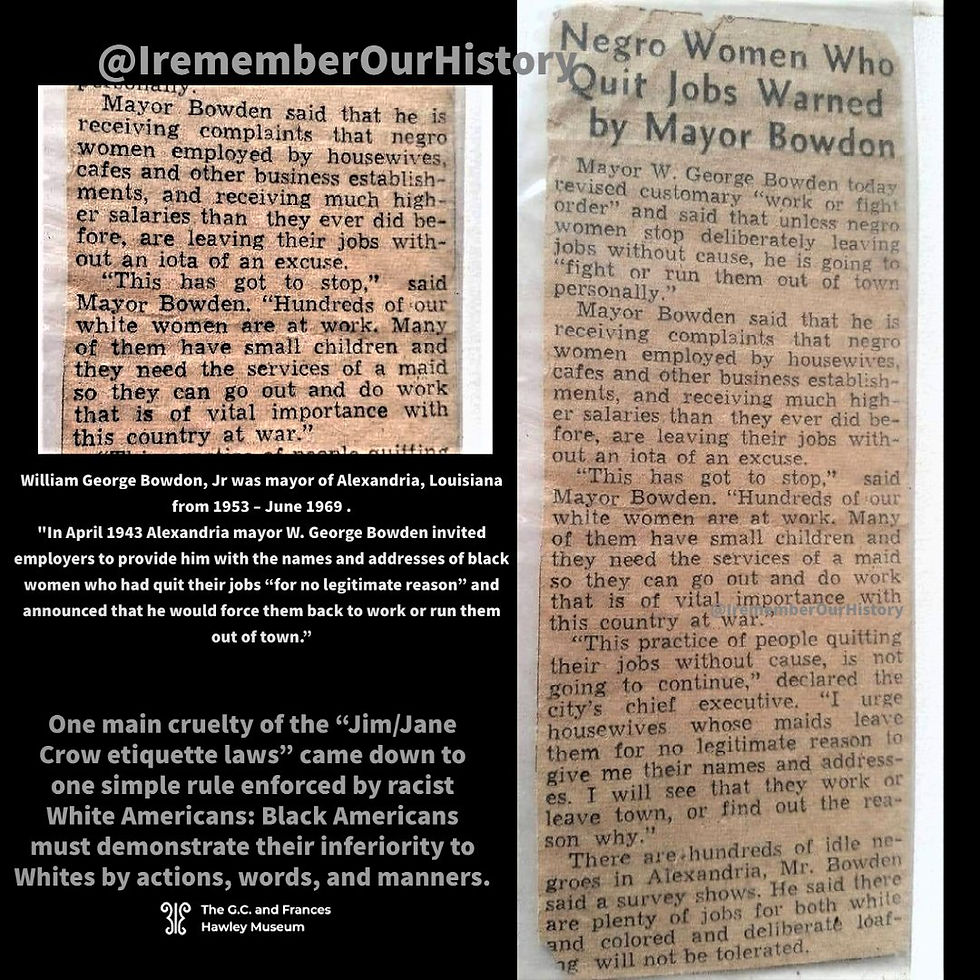
Racial Etiquette
Racial Etiquette: The Racial Customs and Rules of Racial Behaviour in Jim Crow America
By Ronald L. F. Davis, Historian
California State University, Northridge
Most southern white Americans who grew up prior to 1954 expected black Americans to conduct themselves according to well-understood rituals of behaviour. This racial etiquette governed the actions, manners, attitudes, and words of all black people when in the presence of whites. To violate this racial etiquette placed one's very life, and the lives of one's family, at risk.


Reconstruction
The Failure Of Reconstruction Was A Ruthless Act Of Sabotage-
By Michael Gerson-Columnist-WaPo/Opinion
May 6. 2019
Conservatives sometimes accuse the academic left of ignoring the good in U.S. history and emphasizing the horrors. But in some respects, the typical telling of the American story does not focus enough on the horrors.

Resettlement Administration
Image: Rehabilitation client of the Resettlement Administration repays his loan.
Smithfield, North Carolina. 1936.
Photograph by Arthur Rothstein
Source of photo and narrative: Photo and narrative source: The Arthur Rothstein Legacy Project.
--
In 1935, President Roosevelt created the Resettlement Administration (later, part of the Farm Security Administration or “FSA”).

Ruth and Evelyn Pope Part 1
Raleigh, NC -Ruth and Evelyn Pope at the Pope House, c. 1913.
The daughters of Dr. Manassa and Delia Pope.
Courtesy of the Pope House Museum Foundation.
.
Evelyn and Ruth Pope grew up in a brick house on Wilmington Street, in a wealthy Black family that posed a challenge to the racist social order of the early 1900s.

Ruth and Evelyn Pope Part 2
Raleigh, NC -Ruth and Evelyn Pope, with their parents, Dr. Pope and Delia Pope, at the Pope House, c. 1913.
Courtesy of the Pope House Museum Foundation.
.
Evelyn and Ruth Pope grew up in a brick house on Wilmington Street, in a wealthy Black family that posed a challenge to the racist social order of the early 1900s.


Sears Catalog Homes
"For Blacks in the Jim Crow South, Sears catalogs were also a way to claim citizenship and challenge racism.
As scholars have shown, buying from a mail-order catalog allowed African Americans to assert their right to participate as equals in the market, turning the act of shopping via the mail into a political act of resistance.
In a period when many department stores did not welcome African American consumers, or discriminated against them, mail-order catalogs like those offered by Sears proved to be the easiest way to avoid such obstacles.


Slavery In NC
"Slavery has been part of North Carolina’s history since its settlement by Europeans in the late 1600s and early 1700s. Many of the first slaves in North Carolina were brought to the colony from the West Indies or other surrounding colonies, but a significant number were brought from Africa. Records were not kept of the tribes and homelands of African slaves, however, so it’s impossible to know the exact ethnic make-up of North Carolina’s slave population."
Source:http://www.learnnc.org/lp/editions/nchist-newnation/5252

Southern Conference on Race Relations
Words on image: Southern Conference on Race Relations, Durham, N.C., October 20, 1942 : Statement of Purpose
This conference was held at North Carolina College (NCC) , in Durham, North Carolina. The college was later renamed, North Carolina Central University. (NCCU)


Sundown Towns
Historical Database of Sundown Towns
This information is part of the History and Social Justice Website Hosted by Tougaloo College, Tougaloo, MS.
When you click link at the bottom of this you will be redirected to this site, and you can select a state from the map below to view a list of sundown towns.

Sundown Towns Locations In America
Sundown Towns Locations In America
Source: justice.tougaloo.edu/Tougaloo College, Tougaloo, MS.
The Towns, Cities and Counties that are "sundown towns" in North Carolina:
Bakersville, Brasstown, Faith, Graham County, Hot Springs, King, Kure Beach, Mayodan, Mitchell County, Rosman, Southern Shores, Spruce Pine, Surf City, Swain County, Trent Woods, Wrightsville Beach.
...
Welcome to the world’s only registry of sundown towns. On our website just click on a state to see an alphabetical list of all the sundown towns we know about, think may been sundown towns, and have managed to get up onto the site.

The "Mammy" Monument Washington, D.C. Almost Had
Photograph: Sculptor Ulric Stonewall Jackson Dunbar with a maquette of his proposal for the memorial,[1] June 1923.
National Photo Company Collection - Library of Congress Catalog
Title: U.S.J. Dunbar, 6/27/1923 Abstract/medium: 1 negative : glass ; 5 x 7 in. or smaller

The 14th Amendment
June 13, 1866: The 14th Amendment Passed
Time Periods: Reconstruction Period: 1865 - 1876
Themes: African American, Reconstruction, Democracy & Citizenship, Laws & Citizen Rights
Image Description: Sylvia N. Thompson (left) with her daughter Addie Jean Haynes and Addie’s ten-year-old son Bryan Haynes holding up a poster-sized copy of the 14th Amendment at the NAACP Portland office in 1964.


The Goss Family
First and second images: Photo circa 1895 - Pictured is the engagement photo of Lorena and Johnny Goss. Photograph was taken in countryside off Redwood Road. Time was some months before marriage.
Third image: Close-up portrait of Johnny Goss the fiancé of Lorena Holloway. He wears wide-brimmed hat, suit, starched collar, and cravat circa 1890
--
The Goss family history is part of the post-Emancipation history of those formerly enslaved at Stagville plantation, Durham, NC, as freed people navigated railroad labor, sharecropping, migration, and discrimination long after 1865.

The Graves House
"Many know the Graves house in Oberlin Village, but what do we know of the it’s namesake?
Willis Graves (ca. 1856-1942)
Born into slavery in Mississippi shortly before the Civil War, Willis Graves became a brickmason in Raleigh. Graves and his wife Eleanor were early pillars of Raleigh's largest Freedmen's community, called Oberlin, in the mid-to-late 1880s.
Like many builders after emancipation, Graves took a leadership role in the community.
He was named a justice of the peace, served as an election official, and twice ran for State House.


The Kirk–Holden War
The Kirk–Holden war was a police operation taken against the White supremacist Ku Klux Klan organization by the government in the state of North Carolina in the United States in 1870.
The Klan was using murder and intimidation to prevent recently freed slaves and members of the Republican Party from exercising their right to vote in the aftermath of the American Civil War.


The State vs State v. Negro Will (1834) and State v. Manuel (1838)
The State vs State v. Negro Will (1834) and State v. Manuel (1838)
*image of court document*
"On January 22, 1834, Will, a slave belonging to James Battle of Edgecombe County, killed a white man. The killing resulted in the State v. Negro Will case, in which the North Carolina Supreme Court protected slaves from a charge of murder when acting in self-defense."

.jpg)


The Wilmington Race Riot
Image description: Eliza Wootten (left) wrote this letter to her son, Edward, on November 8, 1898, the day that an election was held at Wilmington, North Carolina. On the morning of the 9th, Edward’s father added a note to tell him of the election’s outcome.
Twenty-four hours later, on November 10, 1898, violent white Wilmington citizens began terrorizing, killing, burning down Black citizen's homes and businesses and running them out of town, because many Black citizens had won seats in the election and the white citizens would not allow them to hold seats of power in Wilmington.


Visit of the Ku-Klux
Image description:
Title: "Visit of the Ku-Klux"
by Frank Bellew,
wood engraving, created in 1872 - depicts a Black woman (mother and wife) cooking over a hearth, a man seated alongside her, and three children nearby, as two members of the Ku Klux Klan (KKK) in the doorway one with a rifle, about to enter an the household with intent to commit violence.
Bellew’s portrait is one of the most visceral depictions of KKK violence during the Reconstruction era.
Source: This was an Illus. in: Harper’s weekly, v. 16, no. 791 (1872 Feb. 24), p. 160. / LOC-Library of Congress

WILLIAM HENRY SHEARIN
WILLIAM HENRY SHEARIN
25 September 1870–22 February 1934
Left image: Clockwise from upper left: Gussie Shearin, Wm Henry Shearin, Annie Brown Shearin, and Alexander Moore Shearin. Probably from 1904, Annie’s birth year.17.
Middle image: Shearin home c. 1922. Almost certainly 1010 Fayetteville St.14.

White Government Union
In 1898, a secret racist political society known as the White Government Union committed the only successful coup in the history of the United States in North Carolina.
They then installed white supremacy rule throughout the government of NC, and this is how it started:
In early 1899, the coup-installed NC Jim Crow legislature and governor enacted the Penitentiary Act which created the NC Dept. of Corrections. It was segregated with white guards, and created to deal with the 'uppity negro's' and their white allies who refused to submit to white supremacy rule. The NC DOC did not desegregate until 1982.

Wilbon Community "Piney Wood"
WILBON COMMUNITY “PINEY WOOD”
Holly Springs/Fuquay, North Carolina
Image description: Standing in front of the barn (left to right) Dewar Bunch, Pages’ nephew: sister Annie Blanche Bunch, niece Lula, and Herbert: Cora Mae
(Norris) Lassiter was also raised by her great-aunt Lula and great-uncle Herbert on this farm along
with her cousins Dewar and Annie.


Wilmington
FROM NORTH CAROLINA.; Ill Feeling Between the Freedmen and White Soldiers. Another Proclamation by Gov. Holden Expected. PREPARATIONS FOR THE STATE ELECTION.
The New York Times /From Our Own Correspondent.
Aug. 2, 1865
RALEIGH, N.C., Friday, July 28, 1865.
Dark and mysterious rumors come up here from Wilmington. It is said that the freedmen there have been drilled by the black soldiers, who are on garrison duty in that section, and that they have arms in their houses, which they intend to use to protect themselves with, when the protection now afforded them is withdrawn.


Wyatt Outlaw And Descendant Mr. Samuel Merritt
Wyatt Outlaw (1820 – February 26, 1870) was the first African American elected to be Town Commissioner and Constable of the town of Graham, North Carolina. He was lynched by the Ku Klux Klan on February 26, 1870. His death, along with the assassination of white Republican State Senator John W. Stephens at the Caswell County Courthouse, provoked Governor William Woods Holden to declare martial law in Alamance and Caswell Counties, resulting in the Kirk-Holden War of 1870