Elizabeth Keckley - CONTRABAND RELIEF ASSOCIATION (1862-1865)
At the beginning of the Civil War, there were approximately two million enslaved women.
An estimated 500,000 of these women fled from slavery as soon as white men left their plantations and homes to join the Confederate army.
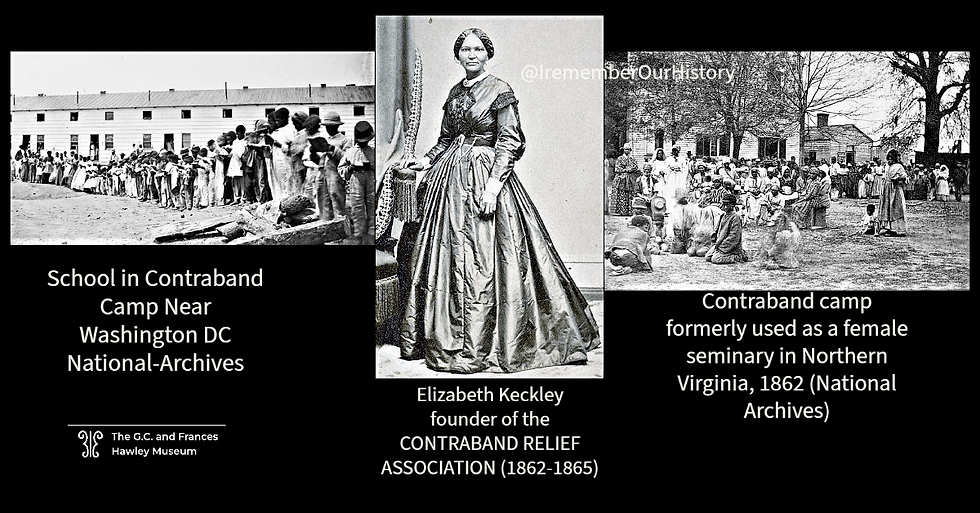
Elizabeth Keckley was born into slavery in 1818 in Virginia.
As an enslaved woman she encountered repeated tortures meant to break her down into submission.
Her book, Behind the Scenes: or Thirty Years a Slave and Four Years in the White House was first published in 1868 and is considered one of the most candid and poignant slave narratives.
Author Elizabeth Hobbs Keckley writes about her teenage years, working as a slave for the Rev. Robert Burwell in Hillsborough, NC. He is thought by many historians to have been Keckley s half-brother.
The Burwells had twelve children and ran an academy for girls. She writes about mistreatment and violence visited upon her by Rev. and Mrs. Burwell, and the rapes by one of the towns white citizens. After Keckley gave birth to a son, she and her baby were sent to live with Burwells sister.
As an enslaved Black woman, Elizabeth Hobbs Keckley endured torture and beatings at the hands of her master and half-brother Robert Burwell in Hillsborough, North Carolina.
She eventually purchased freedom for herself and that of her son for $1,200in the 1850s.
She made her way to Washington, D.C. in 1860 to establish her own dressmaking business and met first lady Mary Todd Lincoln. and is now remembered as an entrepreneur, fashion designer, abolitionist, educator, writer, and community activist.
Just after Abraham Lincoln’s inauguration, in 1861, the FLOTUS hired Keckley (also spelled Keckly) as her personal modiste. Keckley took on the role of dressmaker, personal dresser and confidante, and the two women formed a special bond.
Much has been researched, written and analyzed about Keckley’s life as a result of the unusual friendship. In 1868, Keckley published a detailed account of her life in the autobiography Behind the Scenes: Or, Thirty Years a Slave and Four Years in the White House.
A thorough study of her dressmaking legacy is still being uncovered, though, explained Elizabeth Way, a former Smithsonian researcher and New York University costume studies graduate student who worked for the Smithsonian last summer researching Keckley.
At the beginning of the Civil War, there were approximately two million enslaved women.
An estimated 500,000 of these women fled from slavery as soon as white men left their plantations and homes to join the Confederate army.
Those fleeing from slavery escaped to Union-occupied areas or to Union encampments, where they were referred to as “contraband.” As a result, many large Union encampments had higher populations of African American women than white women.
Following complaints from White Union soldiers about the presence of slavery refugees in Union encampments, the federal government quickly crowded African American men, women, and children into what were known as contraband camps. These camps were overcrowded, overrun with disease, and provided the refugees with little to no sanitation or clothing.
In response to the dire need of the people surviving in contraband camps, Elizabeth Keckley, a dress maker to the First Lady, Mary Todd Lincoln, and a former enslaved person, founded the Contraband Relief Association (CRA) along with 40 African American women from her church, Union Bethel Church in Washington, D.C. The purpose of the CRA was to provide relief, resources, and guidance to slavery refugees.
Mary Todd Lincoln was a major supporter of the CRA and contributed the first $200 to the organization. Through the Contraband Relief Association, of which Keckley became president in 1862, shoes, clothing, and other essentials were collected for formerly enslaved people.
The CRA raised money in Black churches and more than 80 large boxes of essential items were contributed exclusively by African American people in Boston. While there had been other African American relief societies formed to aid freed people and refugees of slavery, no other organization provided assistance on the scale of the CRA.
At Keckley’s behest, as part of her work for the CRA, Sarah Martin established the Fugitive Aid Society of Boston and Octavia Grimes established the Colored Ladies’ Relief Association. These two organizations had ties to Black Boston churches and functioned as auxiliaries of the CRA.
The Contraband Relief Association quickly became a far-reaching and powerful organization, which received donations from Northern Abolitionists, President Abraham Lincoln, Frederick Douglass, and antislavery societies in England and Scotland. Henry Highland Garnet, Frederick Douglass, and Wendell Phillips of the American Anti-Slavery Society were among many abolitionist speakers who were recruited to raise funds for the CRA.
In 1863, large numbers of contraband men began enlisting in Black Union battalions. Though white women had aided white soldiers through their own aid societies, there was no such assistance for African American soldiers.
As a result, the CRA began providing aid in outfitting the contraband soldiers. With its purpose and focus expanded to provide support to African American soldiers, the Contraband Relief Association changed its name to the Ladies’ Freedmen and Soldiers’ Relief Association.
--------------
Source: https://www.jstor.org/stable/24589840
Source: https://www.smithsonianmag.com/.../the-story-of.../
Source: https://www.whitehousehistory.org/from-slavery-to-the...
Source: https://www.loc.gov/.../biographies/elizabeth-keckley.html
Sources by C. Hudson: Judith E. Harper. “Women During the Civil War: An Encyclopedia,” Ebookcentral.proquest.com, https://alliance-primo.hosted.exlibrisgroup.com/.../TN... [login required]; Jacqueline Hubbard, Esq. “Elizabeth Keckley: Her spirit of giving and the Contraband Relief Association,”
TheWeeklyChallenger.com, https://theweeklychallenger.com/elizabeth-keckley-her.../; The Library of Congress. “The Civil War In America,” Loc.gov, https://www.loc.gov/.../civil-war-in.../ext/cw0050p2.html.