Osborn Perry Anderson - Correcting Identities(TM)
.png)
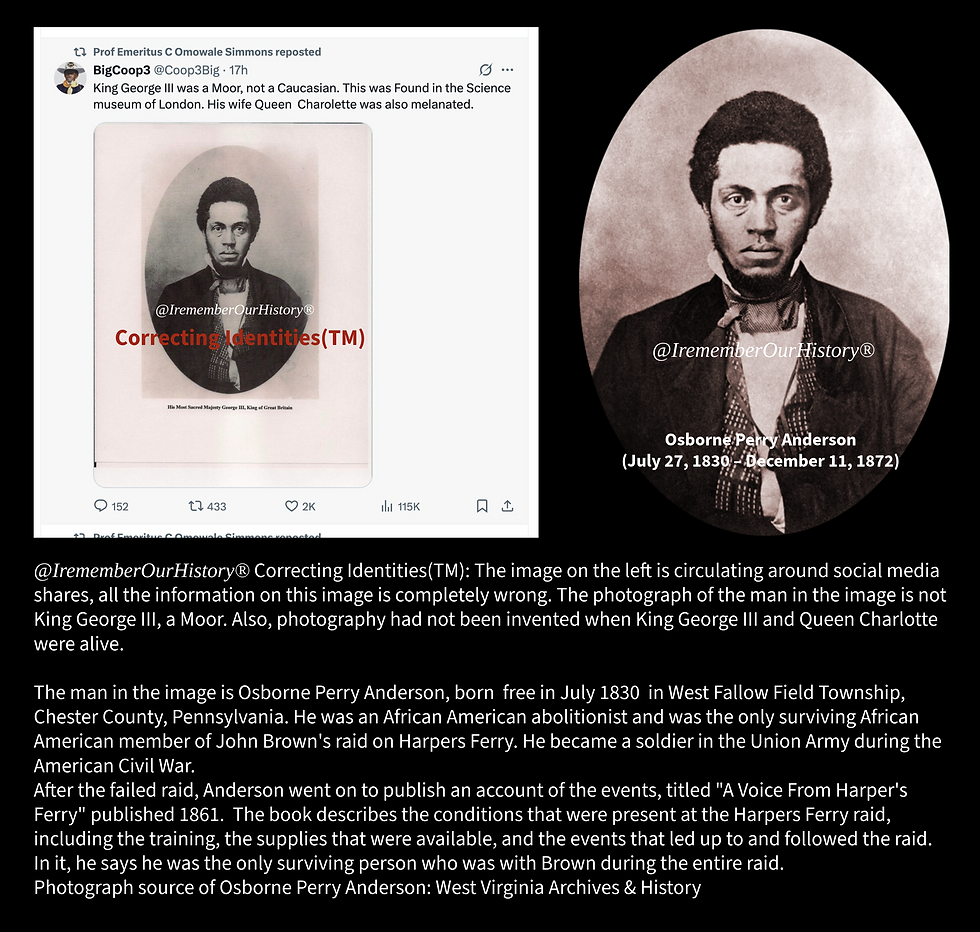
The image on the left is circulating around social media shares, all the information on this image is completely wrong. The photograph of the man in the image is not King George III, a Moor. Also, photography had not been invented when King George III and Queen Charlotte were alive.
The man in the image is Osborne Perry Anderson, born free in July 1830 in West Fallow Field Township, Chester County, Pennsylvania. He was an African American abolitionist and was the only surviving African American member of John Brown's raid on Harpers Ferry. He became a soldier in the Union Army during the American Civil War.
After the failed raid, Anderson went on to publish an account of the events, titled "A Voice From Harper's Ferry" published 1861. The book describes the conditions that were present at the Harpers Ferry raid, including the training, the supplies that were available, and the events that led up to and followed the raid. In it, he says he was the only surviving person who was with Brown during the entire raid.
Photograph source of Osborne Perry Anderson: West Virginia Archives & History
.
Osborn Perry Anderson
He was an African American abolitionist and the only surviving African American member of John Brown's raid on Harpers Ferry, and later a soldier in the Union army of the American Civil War
He was born on July 27, 1830, in Chester County, Pennsylvania, PA, and he died in 1871, Northwest, Washington, D.C., Washington, D.C.
He was buried in: Columbian Harmony Cemetery
He was educated at Oberlin College
Along with John Anthony Copeland Jr., another member of the Brown raiding party, Anderson attended Oberlin College in Oberlin, Ohio. He later moved to Chatham, Canada, where he worked as a printer for Mary Ann Shadd‘s newspaper, the Provincial Freeman. In 1858, Anderson met John Brown and eventually became persuaded to join his band of men determined to attack Harpers Ferry.
One year after meeting John Brown on October 16, 1859, Anderson took part in Brown’s radical scheme to free the United States of slavery. Like Brown and the other followers, Anderson believed that if the group seized weapons at Harpers Ferry and then marched south, they would create a massive slave uprising that would liberate all of the nearly four million African Americans in bondage.
Osborne Anderson was among the five followers of Brown who escaped capture when U.S. Marines attacked the arsenal to stop the raid. He was the only African American to escape capture. In 1861, Anderson, then safely in the North, wrote A Voice from Harper’s Ferry with assistance from Mary Ann Shadd, in which he described his role in the raid.
He argued that many local slaves would have welcomed their liberation, and some, in fact, had helped Brown and his men. Anderson’s account was the only one published by a member of Brown’s party and provided a rare, first-hand description of the events and the motivation of these abolitionists.
In 1864, five years after the Harpers Ferry Raid, Anderson enlisted in the Union Army, serving as a recruitment officer in Indiana and Arkansas. Osborne Anderson died on December 13, 1872 in Washington, D.C. at the age of forty-two.
“A VOICE FROM HARPER'S FERRY"
PREFACE.
My sole purpose in publishing the following Narrative is to save from oblivion the facts connected with one of the most important movements of this age, with reference to the overthrow of American slavery. My own personal experience in it, under the orders of Capt. Brown, on the 16th and 17th of October, 1859, as the only man alive who was at Harper’s Ferry during the entire time—the unsuccessful groping after these facts, by individuals, impossible to be obtained, except from an actor in the scene—and the conviction that the cause of impartial liberty requires this duty at my hands—alone have been the motives for writing and circulating the little book herewith presented.
I will not, under such circumstances, insult nor burden the intelligent with excuses for defects in composition, nor for the attempt to give the facts. A plain, unadorned, truthful story is wanted, and that by one who knows what he says, who is known to have been at the great encounter, and to have labored in shaping the same. My identity as a member of Capt. Brown’s company cannot be questioned, successfully, by any who are bent upon suppressing the truth; neither will it be by any in Canada or the United States familiar with John Brown and his plans, as those know his men personally, or by reputation, who enjoyed his confidence sufficiently to know thoroughly his plans.
The readers of his narrative will therefore keep steadily in view the main point—that they are perusing a story of events which have happened under the eye of the great Captain, or are incidental thereto, and not a compendium of the “plans” of Capt. Brown; for as his plans were not consummated, and as their fulfillment is committed to the future, no one to whom they are known will recklessly expose all of them to the public gaze. Much has been given as true that never happened; much has been omitted that should have been made known; many things have been left unsaid, because, up to within a short time, but two could say they; one of them has been offered up, a sacrifice to the Moloch, Slavery; being that other one, I propose to perform the duty, trusting to that portion of the public who love the right for an appreciation of my endeavor
.
Source: https://www.historyisaweapon.com/.../andersonvoiceharpers...
Source: Source:https://en.wikipedia.org/wiki/Osborne_Perry_Anderson
You can read Osborn Perry Anderson's book here The Project Gutenberg eBook of A voice from Harper's Ferry; a narrative of events at Harper's Ferry: https://www.gutenberg.org/cache/epub/73843/pg73843-images.html