Henry Plummer Cheatham - 1857-1935
Representative 1889-1893
Henry Plummer Cheatham (December 27, 1857 – November 29, 1935) was a formerly enslaved person who became an educator, advocate, farmer and politician. Cheatham was elected as a Republican member of the United States House of Representatives from 1889 to 1893 from North Carolina. He also was the main power behind creating the Colored Orphanage in Oxford North Carolina and was the superintendent 1907-1935.
Note: Rev. G.C. Hawley through his mother, Mrs. Hallie Cheatham Hawley is related to Henry P. Cheatham Sr. - end note.
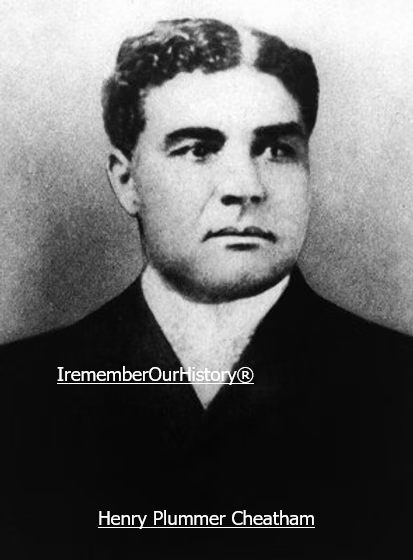
He was one of only five African Americans elected to Congress from the South in the Jim Crow era of the last decade of the nineteenth century. Using disfranchisement tactics to strangle the advancements of Black Americans by reducing the ability for them to vote. After white American violence erupted and ended the reconstruction era, no African Americans would be elected from the South until 1972 and none from North Carolina until 1992.
Henry Plummer Cheatham was born enslaved on a plantation then in Granville Co, near what is now Henderson, North Carolina, on December 27, 1857, and died in Oxford, North Carolina, on November 29, 1935. Henry P. Cheatham is buried in Plummer Cheatham Memorial Park in Oxford, North Carolina
He was the child of an enslaved mother, Mary Adeline Cheatham, and his father is believed to have been her enslaver, Isham G. Cheatham, a wealthy farmer and slaveholder. Isham G. Cheatham was born 31 Dec 1794 in Granville, North Carolina, and died 3 Mar 1871 at age 76 in Granville, North Carolina,
At age eight, Cheatham was emancipated at the end of the Civil War. After the Civil War and Emancipation, Cheatham was educated in the Negro Granville County’s public schools. He received financial aid from a white friend, Robert A. Jenkins, which assisted Cheatham in enrolling at Shaw University, a private historically Black college in Raleigh, North Carolina and the oldest college for African Americans in the state. He graduated in 1883, by 1888 he also received is Master degree from Shaw University.
He became a teacher at the state normal school for Black school teachers in Plymouth, North Carolina;
In 1883 Cheatham was named principal of a teacher-training school in Plymouth, North Carolina after the death of principal Alexander Hicks, Jr.
Cheatham ran a successful campaign for the office of Registrar of Deeds at Vance County, North Carolina in 1884, and he served the county for four years. Cheatham made valuable political connections during his two terms as register.
In 1887, he was part of a group that founded and incorporated an orphanage for Black children in Oxford, North Carolina. He also studied law during his first term in office, with an eye toward national politics.
In 1884, Cheatham married Louisa (or Louise) Cherry, born 15 Nov 1862 - died14 Sep 1899
from Tarboro, Edgecombe County, North Carolina- who had been a fellow student at Shaw. She taught music at the school where he had been principal. They had three children: Charles, Mamie, and Henry Plummer Jr.
Her sister Cora Lee Cherry married George Henry White in 1886, who also became active in politics and was elected as a U.S. Congressman after Cheatham had served.
The proposed Cheatham-White Scholarship program, intended for North Carolina A&T State University and North Carolina Central University students, is named for both congressmen.
After Louisa Cheatham died in 1899, Henry married Laura Joyner married 30 Oct 1901 in Virginia. They had four children: Susie, Richard, and James, and a baby boy who died at birth.
Cheatham became active in Republican politics. He encouraged the establishment of institutions for African Americans, such as the Colored Orphan Asylum in Oxford in 1883 and the founding of state normal schools for the training of Black teachers.
U.S. Congressman
In 1888 Henry Cheatham ran for Congress as a Republican in North Carolina’s Second Congressional District. Cheatham was narrowly elected to Congress from North Carolina's 2nd congressional district over the incumbent Furnifold M. Simmons. (Simmons would later lead the white supremacy campaigns that resulted in a new state constitution that disfranchised Black citizens.)[4]
During the campaign, Cheatham was reported by North Carolina papers to have allegedly told Black voters that Simmons and President Grover Cleveland would re-enslave them. Other press outlets of the time dismissed these allegations by the press as hyperbole or having misrepresented Cheatham's words.
In a period of disfranchisement of Blacks in the South, Cheatham was one of five African Americans elected to Congress during the Jim Crow era of the late nineteenth century. There were two from South Carolina, his brother-in-law George Henry White who followed him from North Carolina, and one from Virginia. After them, no African Americans would be elected from the South until 1972, after federal civil rights legislation enforcing constitutional rights for citizens,[5] and no African American would be elected to Congress from North Carolina until 1992.
Cheatham, then the only Black North Carolina congressman, supported federal aid to education, and the McKinley tariff. He also supported the Federal Elections Bill in 1890, introduced by Henry Cabot Lodge, to provide federal enforcement to safeguard the voting rights of African Americans in the South. House Republicans had been concerned about the discriminatory practices of the Democrats and trying to gain passage of a bill since the 1880s. Lodge's bill narrowly passed the House but died in the Senate. Republicans were unable to get federal legislation passed on this issue as the Southern Democratic voting block became more powerful.
Cheatham tended mostly to the needs of his constituents (of both races) but did not succeed in getting his own bills passed. Cheatham served on the House committees on Education, Expenditures on Public Buildings, and Agriculture, one of the more powerful.[6]
In 1890, Cheatham defended his seat and defeated the Democrat James M. Mewborne, with 16,943 votes to 15,713.[7] But nationwide, Democrats re-took the House of Representatives, which meant that measures to protect Black civil rights would not be passed. Cheatham was the only Black congressman in the Fifty-second Congress (he also had been the only Black congressman in the first half of the 51st Congress).
He unsuccessfully sought re-election to a third term in 1892, after the North Carolina legislature changed the boundaries of his congressional district. Competition from a Populist on the ballot split some of the vote, contributing to the victory of Frederick A. Woodard, a Democrat.[8]
Cheatham ran against Woodard again in 1894 without success.[9] In 1896, he competed for the Republican nomination for the district against his brother-in-law, George Henry White, who won as the next (and last) late nineteenth-century black congressman from North Carolina.
Later life
In 1897, President William McKinley's administration appointed Cheatham as federal Recorder of Deeds for the District of Columbia, a prestigious and lucrative patronage position which he held through 1901 and the change in administrations. Cheatham, a friend and ally of Booker T. Washington, was criticized for standing by McKinley, as the Republican administration did little to offset the rising tide of Jim Crow racism and segregation in the South. New state constitutions were passed in the South from 1890 to 1908 that disfranchised black citizens for more than half a century, but their provisions generally survived US Supreme Court review. If one provision was declared unconstitutional, Southern states passed new ones to create new obstacles.
After four years in Washington, D.C., Cheatham returned with Laura to farm in Littleton, North Carolina.
They both moved back to Oxford, NC when he was appointed superintendent of the state Colored Orphan Asylum, which was located there. He served in that position for 28 years. the name was changed to Central Children's Home and is still in operation today.
Cheatham and other Black men had pushed the state legislation to establish the orphanage in 1883, as part of Reconstruction-era programs to provide for the welfare of people. He was its superintendent and to him more than any man, is due the credit for the remarkable progress and development of the institution. He died in Oxford in 1935.
---
From NYPL Schomburg Center for Research in Black Culture:
Here is some information about one of his sons named Henry Plummer Cheatham Jr. (1890 - 1940).
Henry Plummer Cheatham collection
1912-1941
This collection contains personal correspondence to Cheatham's siblings (Mamie and Charles), describing his military experience while serving in the Philippine Islands, as well as correspondence relating to military regulations during World War I. Also included in the collection is correspondence pertaining to funeral arrangements for Cheatham addressed to his brother Charles Cheatham. There are also programs, an obituary for Cheatham, a speech (possibly by former Congressman Cheatham), and announcements and flyers for an appearance by the congressman.
Biographical/historical information
Henry Plummer Cheatham Jr. (1892-1940) was born in Henderson, North Carolina to ex-Congressman (1889-1890) and superintendent of the Colored Orphanage at Oxford, North Carolina, Henry P. Cheatham, and his wife, Louise Cherry. The younger Cheatham was educated in the public schools of Washington, D.C., and later graduated from Shaw University in Raleigh, North Carolina, and Temple University in Philadelphia, Pennsylvania (1925), where he received a law degree with honors. Prior to attending Temple University, Cheatham enlisted in the United States Army (ca. 1912).
Cheatham served with the 24th infantry in the Philippines for almost the entirety of his enlisted years and earned the rank of Regimental Sergeant Major. After serving in the Philippines, he resided in New York at which time he enlisted in the 15th New York City Infantry. When the United States entered World War I, the 15th was taken over by the War Department and became the 369th United States Infantry. Cheatham served with the 369th in France, and later, he was transferred to the 370th Infantry.
After he was admitted to the Bar, Cheatham opened offices in Philadelphia where he practiced law until a few months prior to his death.
From WikiTree:
Son of Henry Plummer Cheatham Sr. and Louisa Sampson (Cherry) Cheatham. The brother of Charles Ernest Cheatham, Mamie Louise (Cheatham) Wormley , Susie Clayton Cheatham [half] , Richard Turner Cheatham [half] and Laura James (Cheatham) Baptiste [half].
Henry Jr. enlisted in the U.S. Army in 1912 and was assigned to the 24th Infantry Regiment. He served until 1915. Henry married Mavis Hunter in New York in 1916. Henry and Mavis had one son, Henry Bernard Cheatham in 1917. When the U.S. entered WWI Henry enlisted again Nov 27, 1917. He was a 2nd Lieutenant in the 370th Infantry Regiment of the U.S. Army. He passed away in 1940. He is buried at Philadelphia National Cemetery.
....
Continued information about Henry P. Cheatham Sr.
Photo Source: ncdcr dot gov
Sources: Wikitree dot come; Wikipedia; NC History Project Encyclopedia; US House of Representatives: History, Art & Archives (.gov); NC Historical Marker Database
Other source: "Henry P. Cheatham" Archived 2008-10-30 at the Wayback Machine, North Carolina History, Campbell University
"Henry Plummer Cheatham" Archived 2010-07-07 at the Wayback Machine, Black Americans in Congress, US Congress, accessed 5 June 2012
Charlotte Observer Are new N.C. A&T and N.C. Central scholarships aimed at smoothing way for name changes at 3 other black schools?, The Charlotte Observer, May 24, 2016
Our Campaigns - NC District 02 Race - Nov 06, 1888 at www.ourcampaigns.com
"The Negroes’ Temporary Farewell: Jim Crow and the Exclusion of African Americans from Congress, 1887–1929" Archived 2012-04-21 at the Wayback Machine, Black Americans in Congress, US Congress, accessed 5 June 2012
Henry P. Cheatham" Archived 2010-07-07 at the Wayback Machine, Black Americans in Congress, US Congress
Our Campaigns - NC District 02 Race - Nov 04, 1890 at www.ourcampaigns.com
Our Campaigns - NC District 02 Race - Nov 08, 1892 at www.ourcampaigns.com
Our Campaigns - NC District 02 Race - Nov 06, 1894 at www.ourcampaigns.com
My Future Depends Upon You!", The Colored Orphanage of North Carolina, (Oxford, N.C.), 1939, Documenting the American South, University of North Carolina